
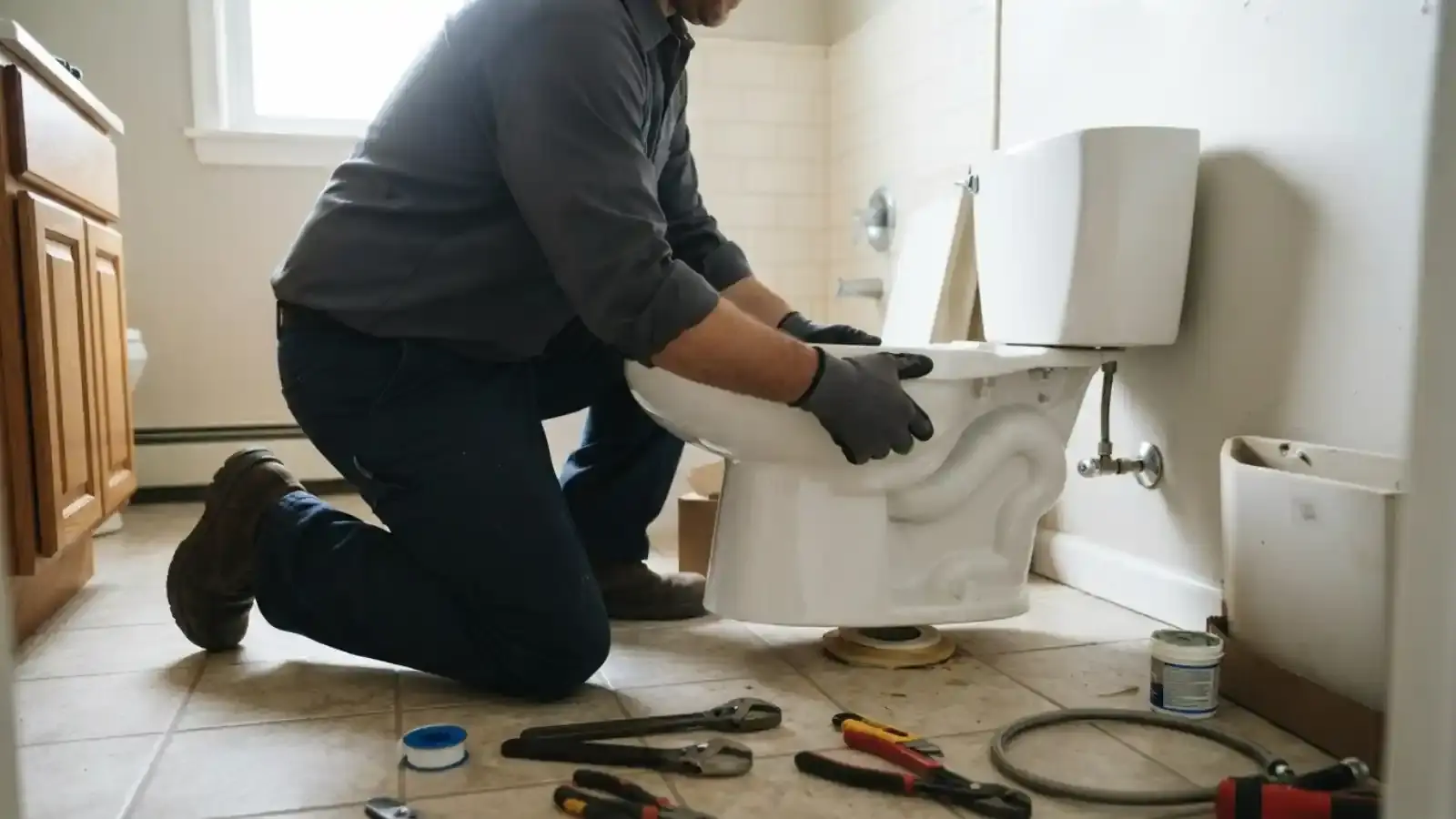
Emergency toilet repair in Placentia, CA covers an overflowing bowl, a leak at the base, a supply line spraying water and a tank that will not stop running. The line is open 24/7 at (714) 750-8637 and a licensed plumber is dispatched to your address. Close the supply valve on the wall behind the toilet first, then call.
Toilet repair is the work of finding which part has failed and fixing it, or replacing the toilet when the porcelain or the floor connection is the real problem. Most calls come down to a clog, a worn fill valve or flapper, a failed wax ring or a leaking supply line. A good visit ends with the cause named, so you know whether it can happen again.
What to do before we arrive: toilet overflowing or leaking onto the floor
Water on a bathroom floor spreads under vanities and into the next room faster than most people expect. The goal in the first minute is to stop new water, not to fix the toilet.
Work through these in order:
- Turn the supply valve clockwise. It sits low on the wall behind the toilet. If it is stuck or spins freely, the fault is in the valve and the plumber will need to shut the main.
- Lift the tank lid and push the flapper down. A bowl that keeps filling while it overflows is often a stuck float or flapper, and holding it closed slows the water.
- Keep power off wet areas. Stay out of standing water near outlets, and turn off the breaker for that room if the panel is dry and easy to reach.
- Do not flush again. Each flush adds more water to a bowl that cannot drain.
If water is coming out of a wall or ceiling and no valve stops it, close the home's main shutoff and call right away. That situation is closer to a burst pipe than a toilet problem.
Reading the symptom: which part is failing
Most toilet faults show themselves in how the toilet behaves. This table lists the common patterns and what the plumber usually finds.
| What you see | Usual cause | Usual fix |
|---|---|---|
| Bowl rises and will not go down | Clog in the trap or the line beyond it | Auger the toilet, or clear the line through a drain cleaning visit if other fixtures are slow |
| Water seeps around the base | Failed wax ring or loose closet bolts | Pull the toilet, replace the seal, check the flange, reset |
| Tank refills every few minutes | Worn flapper or flush valve seat | Replace the flapper or the flush valve |
| Hissing after the flush ends | Fill valve that no longer shuts off | Replace the fill valve and set the water level |
| Drip at the supply connection | Cracked or loose supply line | Replace the line and the shutoff valve if it is corroded |
| Weak flush, slow bowl refill | Mineral buildup in the rim holes | Clean the jets, then check the tank parts |
These are common patterns, not a diagnosis. The plumber confirms the cause on site before quoting the work.
Water at the base: the wax ring and the flange
A toilet sits on a wax ring that seals the bowl to the drain flange in the floor. When that seal fails, water or sewer gas escapes at the base, and the floor around it stays damp. Tightening the bolts sometimes helps for a week, but a rocking toilet usually needs the seal replaced. A properly set toilet follows the California Plumbing Code, Title 24, Part 5, which is built on the Uniform Plumbing Code (UPC).
The plumber pulls the toilet, scrapes the old wax, and looks at the flange. A cracked or low flange will not hold a new seal, so it is repaired or shimmed before the toilet goes back. Soft flooring around the base is a sign the leak has been going on for a while.
If the damp spot shows up even when no one has used the toilet, the source may be a supply line or a pipe behind the wall. That is a job for leak detection rather than a new seal.
Running toilets, phantom flushes and weak flushes
A running toilet is a quiet emergency, because it can waste water all night and show up later on the bill. These are the usual causes.
- A flapper that does not seat. It warps or collects mineral film and lets water slip into the bowl. The tank then refills in short bursts, which sounds like a phantom flush.
- A fill valve that will not close. The float or the valve seal wears out, and water keeps flowing into the overflow tube.
- A chain that is too short or too long. The flapper cannot close fully, or it never lifts all the way. Both are simple adjustments.
- A water level set too high. Water spills into the overflow tube and runs without end. Resetting the float fixes it.
- Rim holes clogged with scale. The bowl gets less water on each flush and the flush feels weak. Hard water is the usual reason.
How a toilet repair visit runs
The visit is short when the cause is clear. Here is the order the plumber works in.
- 01
You describe the symptom
Tell the dispatcher whether the toilet overflows, leaks, runs or flushes weakly, and whether water has reached a floor.
- 02
The plumber confirms the cause
The tank and the supply are checked first, then the base, then the drain beyond the bowl.
- 03
You hear the price before work starts
A clear price is given for the repair or the replacement, and you decide.
- 04
The fix is tested
The toilet is flushed several times, and the base and the supply connection are checked dry.
Repair the toilet or replace it
Most toilets are worth repairing. A new fill valve, flapper or wax ring costs far less than a new toilet, and the bowl is often fine. The plumber may suggest replacement when the porcelain is cracked, when parts for an old model are hard to find, or when the toilet clogs again and again because of its design.
Replacement is also a chance to fit a newer low-flow model and a new supply line and shutoff valve. A full swap is covered under plumbing installation when you want to plan it rather than rush it.
Placentia homes, hard water and toilet parts
Placentia's population grew from about 5,000 in 1960 to nearly 25,000 by 1970, so many homes are now 50 years old or more. Older bathrooms often have original supply valves that have not been turned in decades, which is why a shutoff that will not close is a common surprise.
Much of the city is served by Golden State Water, whose 2026 water quality report lists average hardness of 188 mg/L, roughly 11 grains per gallon. About a third of Placentia is served by Yorba Linda Water District instead, so check your bill. Hard water leaves scale on flappers, fill valves and rim holes, and that shortens the life of the parts. A water softener slows that buildup.
What changes the price of a toilet repair
A clear price is given before work starts. These are the factors that move it.
A flapper or fill valve is a small repair. A new flange or a toilet replacement is a bigger job.
Seal and flange work means pulling the toilet and resetting it, which takes longer.
Soft flooring or a leaking supply behind a wall adds repair steps.
A valve that will not close may need replacing before the work can safely start.
After-hours dispatch carries a different rate than a scheduled daytime visit.
A worn part is maintenance and is rarely covered. Water damage from a sudden overflow can be a separate claim on some policies, so photograph the area and read your policy or ask your agent.
Want your real number for your toilet? Call (714) 750-8637
Questions about toilet repair in Placentia
Yes. The line at (714) 750-8637 is answered around the clock, including nights, weekends and holidays. Tell the dispatcher if water is on the floor so the call is treated as urgent.
A running toilet is not a flood, but it wastes water every hour and often points to a part that is about to fail. If you cannot stop it by closing the supply valve, or the bowl is rising, call right away.
Yes. A failed seal lets water soak the subfloor, and the damage stays hidden until the floor feels soft. Close the supply valve and avoid flushing until it is repaired.
Often. The plumber checks whether the clog is in the toilet or in the line past it. If other drains are slow too, the drain cleaning page explains the next step.
Yes. Landlords and managers can call on behalf of tenants. Give the dispatcher the unit address and whether the tenant can let the plumber in.
The city's Building and Safety office at (714) 993-8124 is the place to ask. Its permit form lists water heaters, water lines, gas outlets, garbage disposals and pipe repair, so a plain toilet swap is a question for them rather than a guess.