
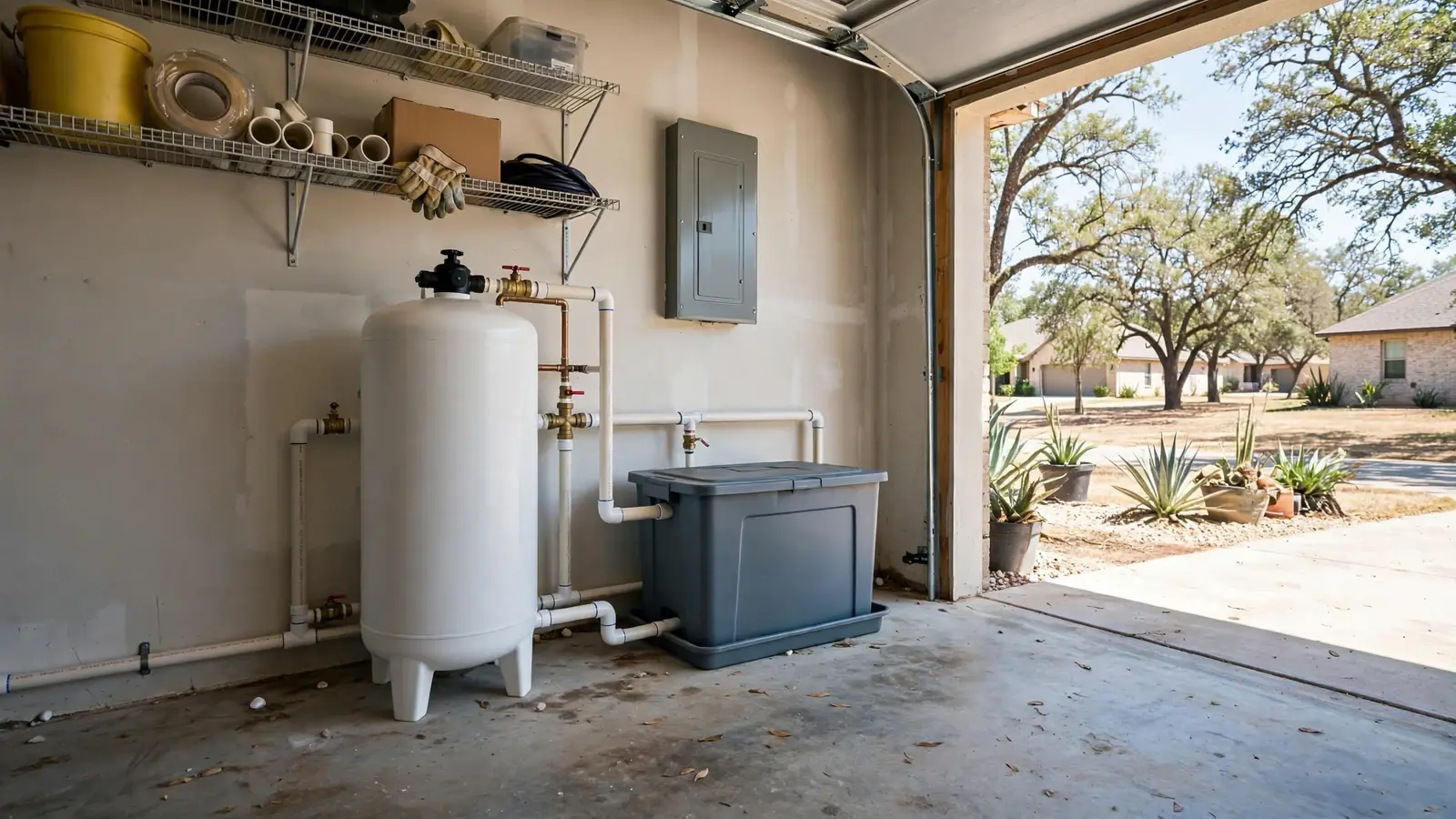
Water softener installation in Placentia, CA means a licensed plumber sets a softener on your main water line, connects it to a drain, adds a bypass valve and programs it for your household. The goal is water that stops leaving scale on faucets, showerheads, dishwashers and the inside of your water heater.
Golden State Water's 2026 report for the Placentia area, which covers 2025 data, lists total hardness between 67.1 and 299 mg/L as calcium carbonate, with an average of 188 mg/L. That works out to roughly 3.9 to 17.5 grains per gallon, and about 11.0 on average. That is well into the range where scale shows up on fixtures and heaters.
Why hardness matters inside your pipes and heater
Hard water carries dissolved calcium and magnesium. When water is heated, those minerals come out of solution and form scale. In a tank water heater, scale builds on the bottom and on the heating element or burner surface, which makes the unit work harder to heat the same water.
Scale also narrows small passages. Showerheads spray unevenly, faucet aerators clog, and washing machine and dishwasher inlet screens collect grit. Tankless heaters are especially sensitive, because their heat exchangers have narrow channels that scale can restrict.
A softener removes hardness minerals at the main line so the whole house gets treated water. That protects every appliance downstream, and it is why softener and heater questions often arrive in the same phone call. The drain and bypass connections follow the California Plumbing Code, which is based on the UPC.
Signs your home would benefit from a softener
You do not need a lab test to know hardness is a problem, though a test is how you size the equipment. These are the everyday clues.
- White crust on faucets and showerheads. The chalky ring that returns a day after cleaning is mineral scale, not soap.
- Spots on glasses and shower glass. Dishwasher spots and cloudy shower doors come from evaporated hard water.
- A noisy water heater. Popping or rumbling from the tank can mean scale has built up on the bottom. See water heater repair if the heater is already misbehaving.
- Stiff laundry and dry skin. Hard water reduces how well soap lathers and rinses out of fabric and off skin.
- Slow flow from fixtures. Scale in aerators and showerheads cuts the flow before it reaches your hands.
Softener types and what each is good for
Not every treatment product softens water. Knowing the difference keeps you from paying for the wrong thing.
| Type | What it does | Good to know |
|---|---|---|
| Salt-based ion exchange softener | Removes hardness minerals and swaps them for sodium or potassium | The standard whole-house approach and needs a drain connection and salt refills |
| Salt-free conditioner | Changes how minerals behave so they cling less to surfaces | Does not remove hardness and results vary, so set expectations before buying |
| Reverse osmosis at one tap | Filters drinking water at a single faucet | A separate job from softening and does not protect the heater or showers |
| Magnetic or electronic descalers | Marketed as scale reducers | Evidence of real results is weak, so ask the plumber for an honest view |
A plumber installs the equipment. Water quality questions about drinking water are best checked against your utility's annual water quality report.
What to do before we arrive to set up the softener
Preparation makes the visit faster and keeps the area safe.
- Locate the main water line. The plumber needs a clear view of where water enters the house.
- Clear space and an outlet. A softener needs room, a drain nearby and, for most models, a power outlet.
- Note how your water behaves. Scale on fixtures, spotty dishes and heater problems help the plumber size the system.
- Keep children and pets away. Cut pipes and the open water line are unsafe to stand near.
How a softener installation goes
Installation is usually a single planned visit. The sequence below is what the plumber works through.
- 01
Confirm your water source and hardness
Check your bill to see whether Golden State Water or Yorba Linda Water District serves you. The plumber tests hardness at your tap to size the unit.
- 02
Choose the location
Most softeners sit near the main water entry with a drain and a power outlet nearby. A garage or side yard is common.
- 03
Cut in, connect and add a bypass
The unit is tied into the main line with a bypass valve so water still flows if the unit is serviced.
- 04
Program, flush and explain
The control head is set for your household, the system is flushed, and you are shown how to add salt and bypass the unit.
What drives the price of a softener installation
The equipment and the labor both vary, so you receive a clear price after the plumber sees the location.
Larger households and harder water need a bigger unit. Oversizing wastes salt and undersizing leaves the water hard.
A nearby floor drain or standpipe keeps the job simple. A long drain run adds pipe and labor.
Old corroded pipe at the cut-in point may need replacement first.
The control head needs power, and the unit needs a level, dry spot with room for salt refills.
The city lists water lines on its permit form, so ask whether your job needs one.
A softener is an improvement, not a claim. It may protect the appliances you already own, so some homeowners treat it as maintenance, and nothing here is a promise about lifespan.
Want to size a softener for your home? Call (714) 750-8637
Placentia water and what to check before you buy
Golden State Water lists Placentia in its Placentia area along with Cowan Heights, Lemon Heights, Orange, Santa Ana and Yorba Linda. Yorba Linda Water District serves roughly one third of Placentia, so check your bill to see who your supplier is. We do not quote hardness for the Yorba Linda district because we have not verified it.
Golden State Water's report also notes that PFAS were sampled at groundwater sources in 2025, with some detections above notification levels and continued monitoring. A softener is not a PFAS treatment. If drinking water quality is your concern, read the utility report and consider a filtration discussion separately from softening.
Fullerton next door reports higher average hardness, about 246 mg/L or 14 gpg, which shows how much water quality can shift across a short distance. Test at your own tap.
Maintaining a softener once it is running
- Keep the salt level up. A salt-based unit stops softening when the brine tank runs empty. Check it monthly and top up.
- Break up salt bridges. A hard crust can form over empty space. Tap the salt gently if water stays hard while the tank looks full.
- Know the bypass. If the unit needs service, the bypass keeps water flowing. Ask the plumber to label it.
- Watch the water heater. After a softener, a heater flush now and then clears loose scale. A new heater benefits most from soft water from day one.
Questions about water softener installation in Placentia
Golden State Water's 2026 report, with 2025 data, lists hardness from 67.1 to 299 mg/L with an average of 188 mg/L, or about 11.0 grains per gallon. That is on the hard side. If Yorba Linda Water District serves you, check with them, because we have not verified their figures.
No. A salt-based softener removes hardness minerals, not PFAS. If drinking water contaminants are your concern, read your utility report and ask about filtration as a separate topic.
The city permit form lists water lines, and a softener ties into your main line. Call Building and Safety at (714) 993-8124 to confirm for your install.
Most are done in a single planned visit, with the water off for a short window. A hard-to-reach drain or an old main line can add time, and the plumber explains that before starting.
It reduces scale buildup in the tank and on heating surfaces. For tankless units especially, softening is a common companion, so mention the heater when you call at (714) 750-8637.
You can buy one, but cutting into the main line, setting a drain connection and testing for leaks is plumbing work. A licensed plumber also confirms whether a permit applies.