
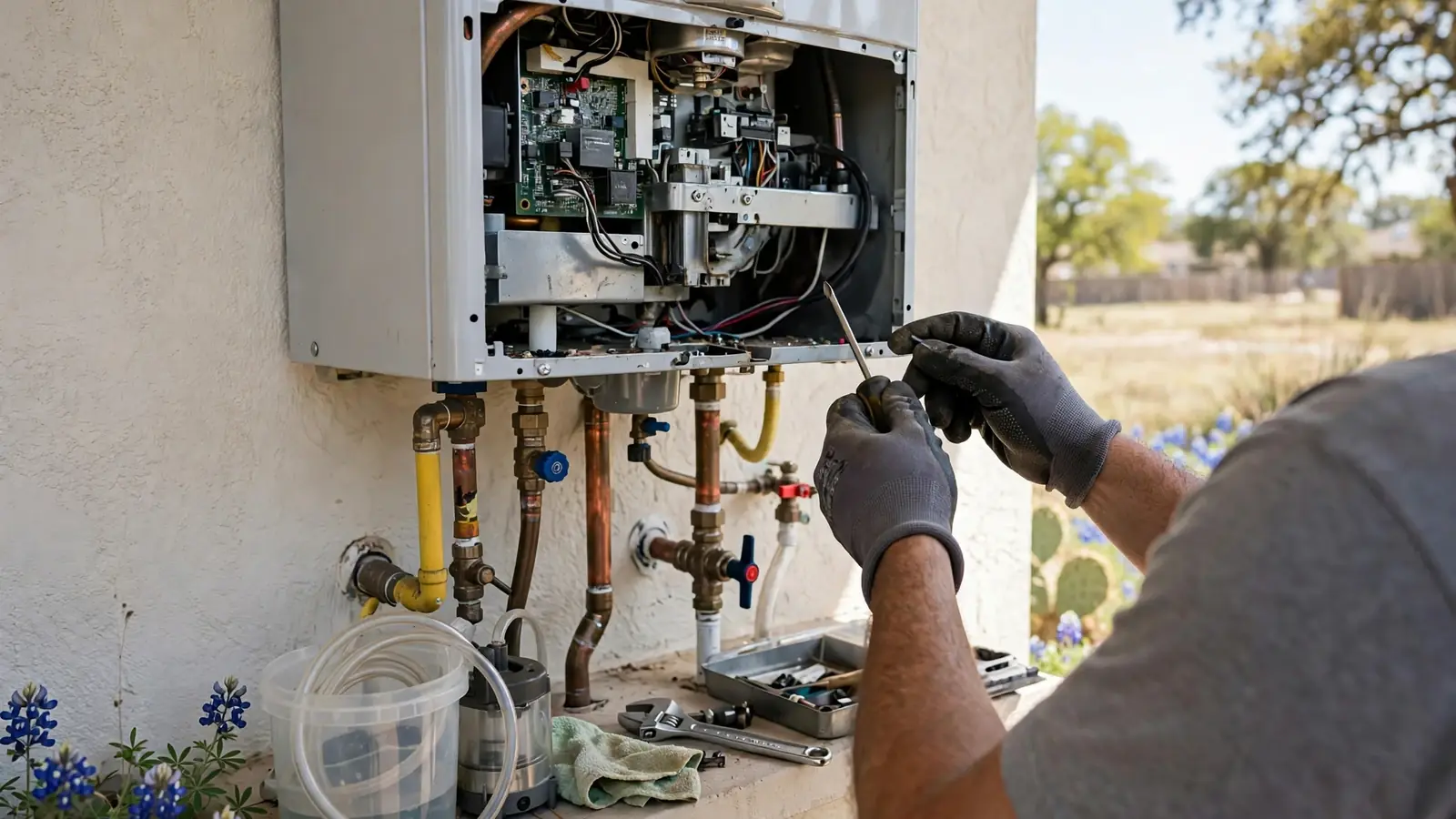
Tankless water heater service in Placentia, CA covers installation, replacement, flushing, descaling and repair for gas and electric on-demand units. Call (714) 750-8637 to schedule, and same-day appointments are offered when available.
A tankless unit heats water as it flows instead of storing it. That can save space and give a steady supply, but it needs the right fuel capacity, venting and regular upkeep. Hard water makes the upkeep part more important than many owners expect.
Why tankless units need a flush in Placentia
Inside a tankless heater, water passes through a heat exchanger with narrow passages. Minerals in the water bake onto the surfaces and narrow those passages, which cuts flow, raises the temperature the unit must work at and often triggers an error code.
Golden State Water's 2026 report for the Placentia and Yorba Linda system lists hardness averaging 11.0 grains per gallon, with a range from 3.92 to 17.5. That is enough for scale to build up over time. Check your bill, because Yorba Linda Water District serves about one third of the city and its water may differ.
A flush circulates a descaling solution through the exchanger, then rinses it out. It is the single most useful maintenance step for a tankless unit, and many owners schedule it on a regular interval.
Signs a tankless unit needs service
- Water that swings hot and cold. Scale in the exchanger or a sensor fault can cause temperature swings.
- An error code on the display. Note the code and the brand when you call. Many codes point to flow, ignition or venting issues.
- Reduced flow at the tap. Clogged inlet screens or scale narrowing the exchanger reduce flow.
- A leak at or under the unit. Water at the base can be a failed fitting or a failed exchanger. The plumber traces it.
- A unit that was never flushed. If you inherited the home and no one remembers a service, it is overdue.
Tank or tankless: the practical differences
Both work well when sized and installed properly. This table sticks to practical points.
| Point | Tank | Tankless |
|---|---|---|
| Hot water supply | Limited by tank volume and recovery | Continuous while within the unit's flow rating |
| Space | Needs floor space for the tank | Wall mounted, smaller footprint |
| Gas and venting | Standard sizing and flue | Often needs a larger gas line and specific venting |
| Maintenance | Tank flush and anode rod | Exchanger flush and descaling |
| Replacement path | See water heater replacement | Install covered on this page |
What a tankless service visit includes
The visit follows the unit's own maintenance sequence.
- 01
Shut off water, gas or power
The unit is isolated so the service valves can be opened safely.
- 02
Check screens and the readout
Inlet filters are cleaned and any stored error codes are read.
- 03
Circulate descaler through the exchanger
A pump and descaling solution run through the exchanger for the time the manufacturer specifies.
- 04
Rinse, restart and test
The unit is flushed, restarted and checked for temperature, flow and leaks.
Installing or switching to tankless
A switch to tankless is a bigger project than a tank swap. Gas models often need a larger gas line than a tank unit, a dedicated venting path and sometimes a condensate drain. Electric models can need a large circuit and panel capacity.
The plumber measures the existing hookups, the run to the new location and the fixtures drawing hot water, then explains what the unit needs. If an existing tank is failing at the same time, the decision may begin on the water heater repair page.
Earthquake bracing rules under California Health and Safety Code section 19211 apply to water heaters broadly, and the plumber confirms how they apply to a wall-mounted unit. Ask the Building & Safety Division at (714) 993-8124 about permit questions. The California Plumbing Code, Title 24 Part 5, is based on the Uniform Plumbing Code (UPC), so ask your installer how it applies to a wall-mounted unit.
Questions to settle before choosing a unit
These keep a tankless project from running into surprises.
Gas line capacity
Can the existing line carry the unit's demand, or does it need a larger run?
Venting path
Where does the flue exit, and can the wall or roof route be used?
Electric supply
Does the panel have room for the circuit an electric model asks for?
Water quality
Will scale be a recurring issue? A water softener can reduce it.
Safety steps for gas and electric tankless units
- Smell gas, leave first. Get everyone outside and call SoCalGas at 1-800-427-2200, then 911 if there is danger.
- Do not reset a unit that keeps faulting. Repeated error codes mean a cause needs diagnosing.
- Keep the vent path clear. Do not store items against the exhaust or air intake.
- Shut off power and water before a flush. Turn off the breaker or gas valve first, then close the isolation valves.
What shapes the cost of tankless work
A clear price is given before work starts. These are the factors.
Larger units and condensing models cost more than smaller ones.
A bigger gas line or a new circuit adds labor and materials.
A new flue path through a wall or roof takes time and materials.
Old shutoffs and connections are brought up to date during a swap.
A flush is a quick visit. A full install is a project.
A tankless unit that fails is usually a warranty or maintenance matter, not an insurance one. A resulting leak may be covered, so keep photos and ask your agent.
Want a real figure for your tankless project? Call (714) 750-8637
Tankless water heater questions in Placentia
Follow the manufacturer's interval, and plan shorter intervals where water is hard. Golden State Water reports average hardness of 11.0 grains per gallon in Placentia, so regular flushing is worthwhile.
Both. Error code diagnosis, part swaps, flushing and full replacement are all handled. Call (714) 750-8637 and mention the brand and code.
It depends on your gas line, venting path and hot water demand. The plumber measures those before suggesting it.
Sometimes. The venting, gas and wall space decide whether it can go where the tank was or needs a new location.
Shut off the water and power or gas to the unit and call. The 24/7 line is open, and the plumber can trace the leak. A bigger hidden leak may need leak detection.
California Health and Safety Code section 19211 covers water heaters broadly. The plumber confirms the mounting for your unit.