
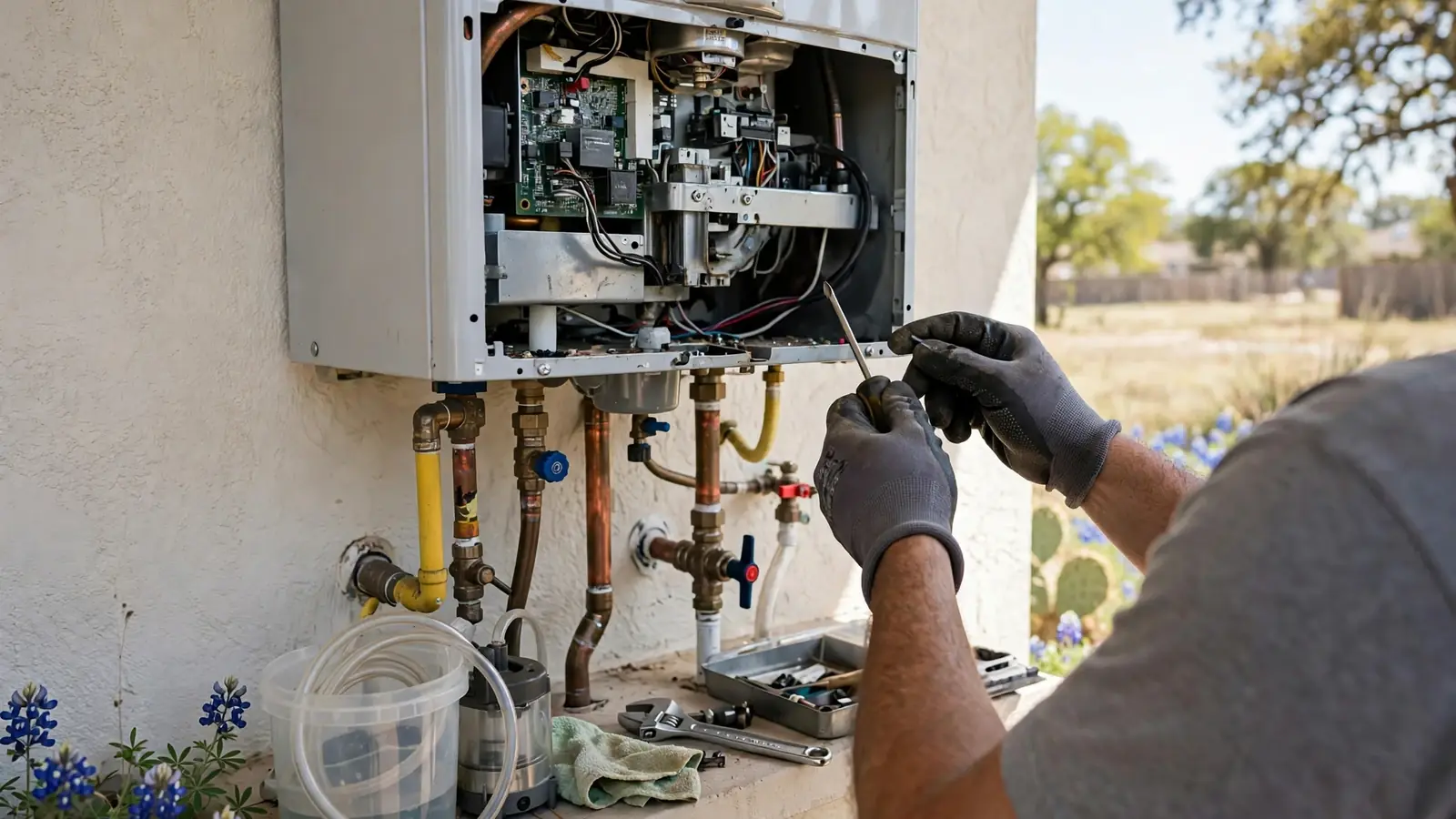
If you are weighing a tankless water heater in Placentia, the water itself deserves as much thought as the heater. Hard water leaves scale behind when it is heated, and a tankless unit heats a lot of water through very small passages.
This guide explains how a softener and a tankless heater work together, what the local water report says, and how to decide on the order of the two projects. It does not replace your heater manufacturer's instructions or your water utility's data.
Why a tankless heater is sensitive to scale
A tank heater stores water and heats it slowly. A tankless unit heats water instantly as it flows through a compact heat exchanger. That exchanger has small channels, so scale that would sit harmlessly at the bottom of a tank can restrict flow and reduce heating efficiency.
When scale builds, the unit may show error codes, deliver lukewarm water or shut down. Manufacturers commonly describe periodic descaling as routine maintenance, and some tie warranty terms to water quality, so read the manual before you buy.
A softener upstream of the heater lowers the hardness that reaches it. That is why plumbers often raise the two together, and why the water softener installation page is a natural companion to the heater page.
How the two systems work together
Think of the softener as the water treatment and the heater as the appliance that benefits from it.
- The softener treats the whole house. It sits on the main line, so every fixture and the heater receive softened water.
- The heater gets a gentler workload. Less mineral buildup means fewer descaling visits and steadier flow.
- The two share a plumbing footprint. Both need space, a drain nearby and in some cases electrical power, so planning the layout once avoids duplicate work.
- Each needs its own service routine. Salt for the softener, a descale or flush for the heater.
What the local water report tells you
Local figures are the starting point, though your own tap is the real test.
| Item | Figure | How to use it |
|---|---|---|
| Golden State Water hardness range | 67.1 to 299 mg/L (3.92 to 17.5 gpg) | Shows hardness can vary across the system |
| Golden State Water average hardness | 188 mg/L (about 11.0 gpg) | Well into the range where scale shows on fixtures and heaters |
| Fullerton city water average | 246 mg/L (about 14 gpg) | A neighbor example of how hardness can run higher nearby |
| Yorba Linda Water District | Not verified here | Check the district's report if your bill shows them |
Golden State Water's figures come from its 2026 report, which covers 2025 data.
A sensible order for the two projects
You can do both at once or in stages. This order protects the heater most.
- 01
Check your water supplier and test hardness
Your bill shows whether Golden State Water or Yorba Linda Water District serves you. Test at your tap.
- 02
Install the softener first or at the same visit
That way the new heater never sees untreated water.
- 03
Install the tankless heater
The plumber confirms gas line capacity, venting and any electrical needs before the unit goes in.
- 04
Set a maintenance routine
Salt checks monthly and a heater service interval based on the manufacturer's guidance.
Hard water and heaters in Placentia
Golden State Water's Placentia area also covers Cowan Heights, Lemon Heights, Orange, Santa Ana and Yorba Linda, and its 2026 report lists an average hardness of 188 mg/L for the system. Yorba Linda Water District serves about one third of Placentia, so your own bill decides which report applies to you. Any new piping for the pair falls under the California Plumbing Code, Title 24, Part 5, a state code built on the Uniform Plumbing Code (UPC).
In practice, that means a Placentia homeowner on Golden State Water is dealing with water that is hard enough to leave visible scale. If you are planning a tankless unit, factor in softening early. The Yorba Linda plumber page covers nearby ZIP codes if you live across the border.
The same report notes PFAS sampling at groundwater sources, with some detections above notification levels. A softener does not address that, so treat drinking water treatment as a separate question.
What a tankless install needs that a tank does not
Gas tankless units usually draw more gas at once than a tank heater, so the gas line has to be sized for the demand. The venting is different too, often using specific vent materials that the manufacturer lists. Electric tankless units pull a heavy load that some home panels cannot supply without electrical work.
The licensed plumber checks these points before quoting, so ask what was checked and what the clear price includes. The tankless water heater page lists the questions to raise on a visit.
The City of Placentia permit application lists water heaters and gas outlets, so call Building and Safety at (714) 993-8124 to ask whether your install needs a permit.
What to do before you decide
- Read your latest water report. Your supplier publishes one every year.
- Look at your fixtures. White crust on faucets and showerheads shows scale.
- Read the heater manual. It states water quality limits and maintenance steps.
- Plan the space. A softener and a heater both need a spot with drain and power access.
Softener and tankless heater questions in Placentia
Not required by law, but the Golden State Water average of about 11.0 gpg means scale is likely. Many plumbers recommend softening, and your manufacturer's manual may set water quality limits.
The softener, or both at the same visit, so the heater never runs on untreated water.
No. A salt-based softener removes hardness minerals only. Read your utility's report for contaminant information.
Check your water bill. Golden State Water serves much of Placentia and Yorba Linda Water District serves roughly one third.
Often the work can be planned together. Call (714) 750-8637 to describe your home, and the plumber will give a clear price before starting.