
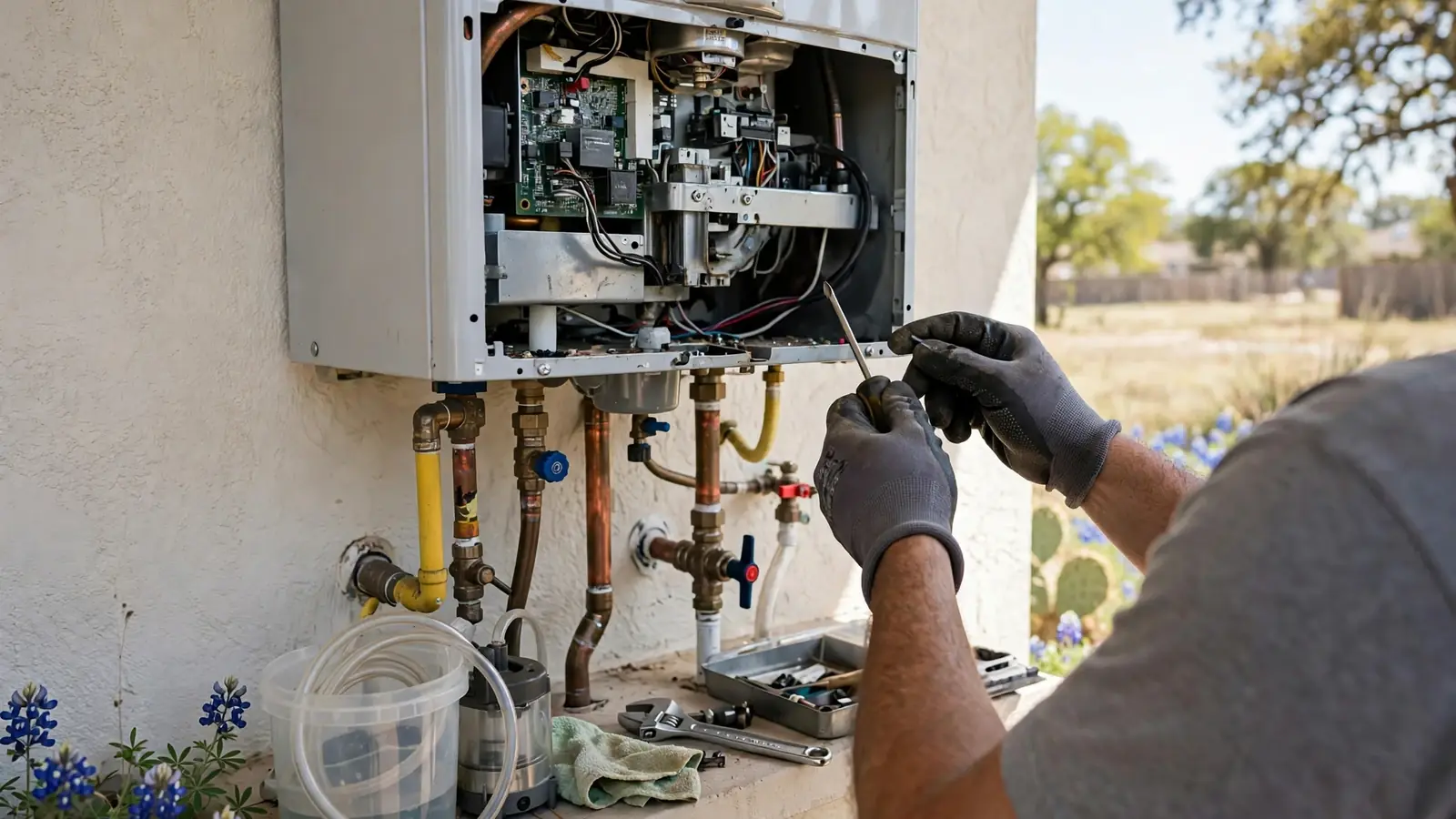
Electric tankless water heaters heat water only when a tap is open. There is no tank to keep warm, which is why they save floor space and avoid standby heat loss. The trade-off is power. Heating a fast stream of cold water takes a very large burst of electricity, and many homes were wired long before such a load was planned.
This guide shows how to turn a kilowatt rating into amps, how that compares with the panel and breakers you already have, and where a gas model or a tank may be the better fit. Questions on a specific house go to a licensed plumber on (714) 750-8637.
Kilowatts, volts and amps in plain terms
Every electric heater is rated in kilowatts, or kW. A whole-house tankless unit runs on a 240 volt circuit, and the current it draws is the wattage divided by the voltage. A 24 kW unit therefore pulls 24,000 divided by 240, which is 100 amps while it runs at full output.
That is the maximum, not the constant. The unit modulates its power to match the flow and the temperature rise needed. A short shower in warm weather draws less than a long fill of a tub on a cold morning.
Breakers are sized above the running load, since a continuous load should not sit at the breaker limit. A heater that draws 100 amps at full output is usually fed by more than one breaker, and each breaker has its own wire.
Rough amp draw by heater size
The figures below use the simple kW to amps formula at 240 volts. The nameplate on the actual heater is what the electrician follows.
| Heater rating | Full-load amps at 240 V | Typical use |
|---|---|---|
| 3 to 5 kW | About 13 to 21 amps | A single handwash sink or small point-of-use unit |
| 11 to 14 kW | About 46 to 58 amps | A bathroom or a small apartment with low flow needs |
| 18 kW | 75 amps | A one-bath home in a mild climate |
| 24 kW | 100 amps | A typical whole-house unit for a family |
| 27 kW | About 112 amps | A larger home with several fixtures running |
Always follow the manufacturer's installation manual and the local electrical code for breaker and wire size. This table is only a way to see the scale of the load.
Why the main panel matters more than the heater
A home service panel has a main breaker, commonly 100 or 200 amps. Everything in the house shares it, including the air conditioner, the range, the dryer and now the heater. A 100 amp heater load next to those appliances can use up most of a 100 amp service on its own.
That is why a panel upgrade, a service upgrade, or a smaller heater is part of many electric tankless quotes. A licensed electrician or plumber should run a load calculation before anyone buys the unit.
What to do before you buy
- Main breaker size. It is printed on the main breaker in the panel. A small service limits how big an electric heater can be.
- Open slots in the panel. A large heater needs two or three double-pole breakers, and each one needs its own space.
- Wire route to the heater location. Heavy copper wire from the panel to the wall costs more the longer the run.
- Peak hot-water use. Count the fixtures that run at once. A kitchen sink and a shower together define the flow the heater has to handle.
- Incoming water temperature. Colder water means a bigger temperature rise and a larger draw. Winter flow in California is easier than in cold states but not free.
Electric, gas or a tank: where each one fits
A gas tankless heater needs a larger gas line and a proper vent, but it asks nothing of the electrical panel. An electric tankless heater needs no vent and no gas line, but it does need the panel capacity above. A conventional tank has none of those demands.
If the panel is full, a gas unit or a tank is usually the cheaper path. If gas is not available at all, or the heater serves a single bathroom, a smaller electric unit can work. The product itself is covered on the tankless water heater page.
Moving from a tank to any tankless model is a real installation, not a swap. It touches water, gas or electric, and often the vent, so water heater installation covers the full scope.
What Placentia hard water and permits mean for a tankless unit
Golden State Water reports an average hardness of 11.0 grains per gallon for the Placentia and Yorba Linda system, with a range up to 17.5. Part of Placentia is served by Yorba Linda Water District, so check your bill for your utility. Water at those levels leaves scale inside a tankless heat exchanger, and scale reduces output and shortens the unit's life.
The plumbing side of an electric unit follows the California Plumbing Code, Title 24, Part 5, which is based on the Uniform Plumbing Code (UPC), while the wiring is a separate trade.
That is why manufacturers call for periodic flushing, and why some homeowners add a water softener ahead of the heater. Ask the installer how the warranty treats hard water.
The City of Placentia permit form lists water heaters among its plumbing items. Ask the Building and Safety Division at (714) 993-8124 how a conversion to electric is handled before work begins.
Electric tankless questions in Placentia
Sometimes a small unit fits, but a whole-house heater of 18 kW or more can use most of a 100 amp service by itself. A load calculation by a licensed professional is the only reliable answer.
It removes standby heat loss from a tank, but the savings depend on how much hot water the household uses. Electric rates and any panel upgrade belong in the math, so ask for the full cost before deciding.
Divide the watts by the voltage. A 27 kW heater is 27,000 watts, and 27,000 divided by 240 is about 112 amps at full output.
It can be. If the unit cannot raise the water temperature enough at the flow you use, it shuts down output to protect itself. A plumber can check the flow rate and the incoming temperature.
Yes. The same line covers them, and the Yorba Linda plumber page lists the ZIP codes served.