
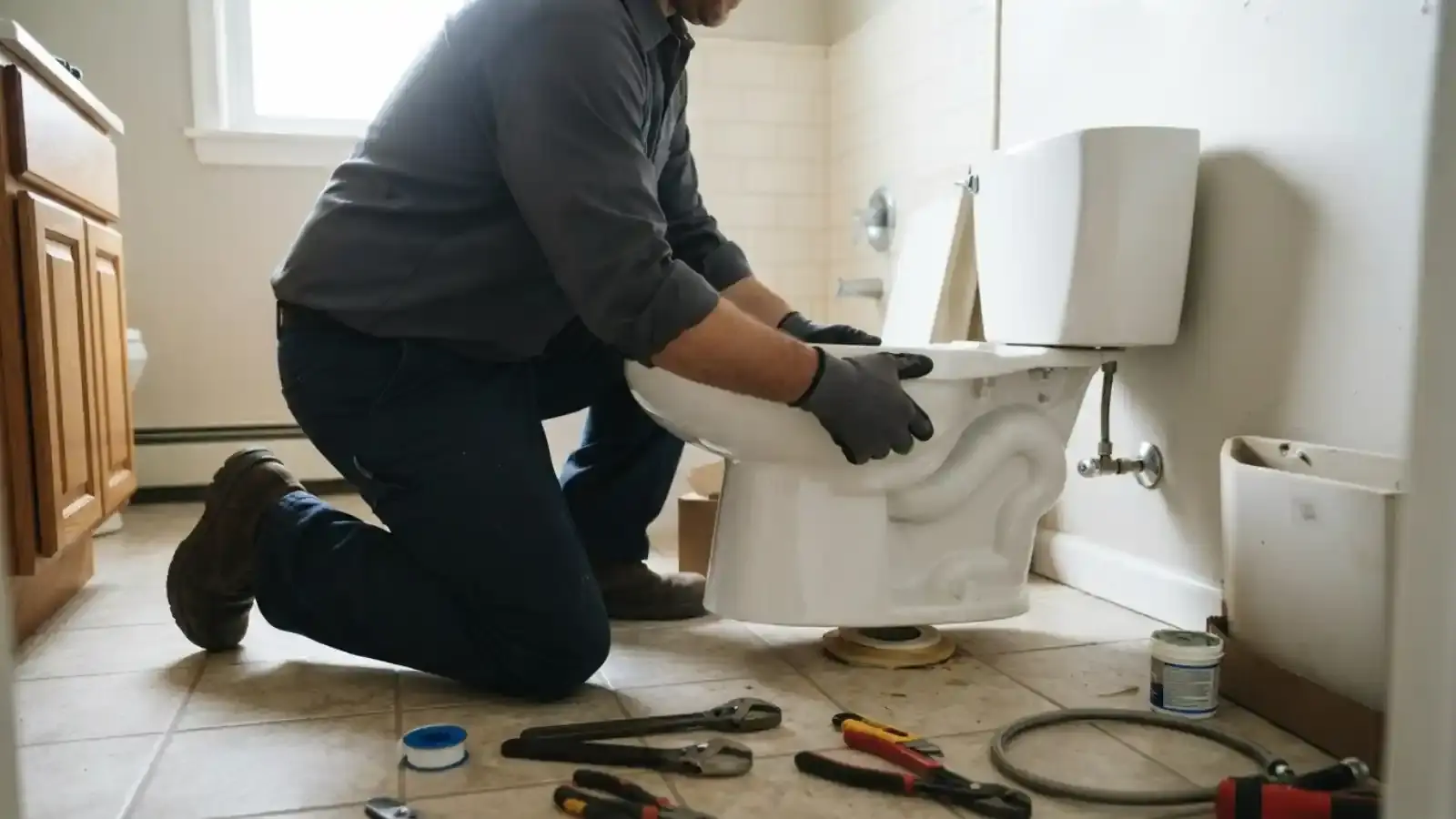
If your toilet bowl is filling and you cannot find a plunger, the first move is to stop the water, not to flush again. Lift the tank lid, lift the float, or close the supply valve on the wall behind the toilet. That keeps a clog from becoming an overflow while you work out the next step.
Most single-toilet clogs are paper and waste that settled in the trap, the curved pipe built into the base. Hot water, dish soap and patience clear a surprising number of them. If those fail, or if more than one fixture is acting up, the line past the toilet is the problem and the 24/7 line at (714) 750-8637 is the right call.
Five things to try before you call anyone
Work through these in order and stop the moment the bowl drains. Each one is gentle on the porcelain and on the pipe.
- 01
Stop the refill
Close the supply valve or lift the flapper chain gently so the tank does not keep sending water into a full bowl.
- 02
Add dish soap
Squeeze about a quarter cup of liquid dish soap into the bowl. It coats the clog and the pipe wall so the blockage can slide.
- 03
Pour in hot water
Use water from the tap or a kettle that is hot but not boiling. Pour from waist height so the stream pushes down. Boiling water can crack porcelain.
- 04
Wait, then try a flush
Give it 15 to 20 minutes. If the level drops, flush once and see if it clears. If the bowl rises again, stop.
- 05
Try a wire hanger or hand auger
Straighten a hanger, wrap the tip in a rag, and feed it gently into the drain opening. A hand auger from a hardware store reaches further and scratches less.
What not to do with a stuck toilet
A few popular fixes make a bad night worse. Avoid these even when you are tired and the bowl is nearly full.
- Do not use chemical drain cleaner. The liquid sits in the bowl without reaching the clog, and it can splash on skin or damage the finish. It also becomes a hazard for the plumber who has to work on the line afterward.
- Do not keep flushing. Each flush adds more water to a bowl that cannot drain, and the floor is where it goes next.
- Do not push hard with a brush or stiff tool. Porcelain chips, and a tool that slips can scratch the inside of the trap, which then catches paper more easily.
- Do not flush wipes, even the ones marked flushable. They do not break down like paper and are a leading cause of repeat clogs in the main line.
- Do not take the toilet off the floor unless you are ready for it. Pulling a toilet leaves an open sewer pipe and a wax seal that must be replaced when it goes back.
Why a toilet clogs in the first place
A toilet is designed to move a lot of water quickly through a narrow trap. When something bulky or slow to dissolve enters that trap, the water cannot carry it through. Too much paper, a toy, a wipe, or a feminine product are the usual causes.
Low flush power is the other common reason. A flapper that closes too early, or a tank that does not fill to the line, sends less water through the bowl, so a normal load stalls halfway. If one toilet clogs often while the others do not, a toilet repair visit to check the flapper, fill level and flange can be cheaper than repeated clogs.
Age matters too. Older toilets in older homes may be low-flow models from an era when flush design was still catching up, and they clog more easily than newer ones.
Signs the clog is not in the toilet
Sometimes the toilet is the messenger, not the problem. If the blockage sits in the branch or the main drain, no amount of soap or hot water will clear it.
Call the 24/7 line at (714) 750-8637 if you see any of the following:
- More than one fixture is slow or gurgling. A shower that drains slowly when the toilet flushes points to a shared line.
- Water rises in the tub or a floor drain when you flush. That is a backup, and the main line is the likely location.
- The toilet clogs again within a day of clearing it. Something deeper is catching paper before it reaches the main.
- There is a sewage smell near the floor drain or cleanout. Stop using water in the house until a plumber has looked.
A plumber can clear the line with a larger auger or drain cleaning equipment, and a camera shows whether roots or a broken joint are involved.
Plunger, auger or plumber: which fits your situation
This quick guide matches the symptom to the right level of help.
| Situation | Try first | Call when |
|---|---|---|
| Slow flush, single toilet | Dish soap and hot water | It returns within days |
| Bowl full, will not drain | Hand auger or hanger with rag | The auger meets a hard stop |
| Several fixtures slow | Stop water use at once | Immediately, a main line may be involved |
| Water rising at a floor drain | Shut off the toilet supply | Immediately, a backup is in progress |
These are general guides. If you are unsure, the dispatcher can talk through your symptoms.
What the Placentia sewer system means for toilet clogs
The City of Placentia says its sanitary sewer system is roughly 50 to 100 years old, with about 84 miles of gravity sewer. A system of that age is more likely to catch wipes, grease and roots at joints, which is why a toilet that keeps clogging can be a sign about the pipe and not only the fixture.
Drain and trap layouts behind a toilet follow the California Plumbing Code, Title 24, Part 5, itself based on the Uniform Plumbing Code (UPC).
Placentia also grew fast, from about 5,000 residents in 1960 to nearly 25,000 by 1970, so a lot of homes here are decades old. If a camera shows the trouble is in the city main and not your own line, Public Works at (714) 993-8131 is the office to ask. For help getting the camera view, a sewer inspection shows where the blockage sits.
Questions about unclogging a toilet in Placentia
If the bowl is rising or water is on the floor, call right away at (714) 750-8637. If the bowl is full but stable and you are trying the soap and hot water method, give it about 20 minutes before deciding.
No. Chemical cleaners can splash, damage the finish, and leave a hazardous liquid sitting in the bowl for the plumber to work around. Mechanical clearing is safer.
It makes repeat clogs more likely to be a pipe issue than a toilet issue. The City describes its sewer system as 50 to 100 years old, and older private lines can have root intrusion or offset joints. A camera look tells you which.
Yes, if the clog sits past the toilet branch. Water then takes the path of least resistance to the lowest drain, often a tub or a floor drain.
Yes. The line is open 24/7, and same-day appointments are offered when available. Clear price before work starts.
Not always. Check the flapper, fill level and drain path first. A toilet repair visit can sort out whether the fixture or the line is the cause.