
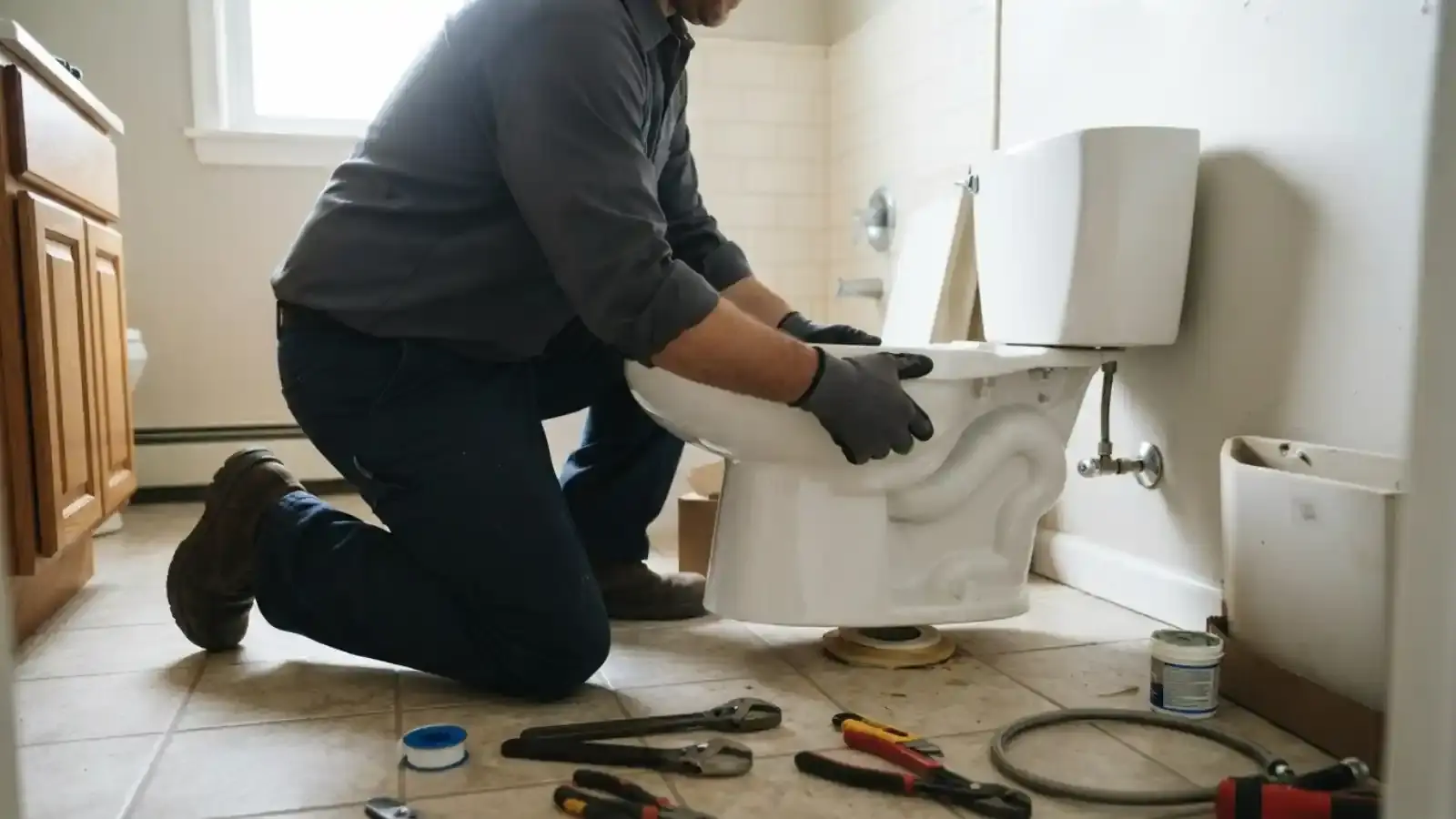
A toilet sits on a flat ring of wax that seals the bowl to the drain flange in the floor. When that seal fails, every flush pushes a little dirty water out at the base instead of down the pipe. The stain on the floor grows slowly, and the subfloor underneath can rot long before anyone notices.
This guide explains how to confirm a failed wax ring, what replacing one involves, and the point where it stops being a one-hour job. If water is spreading across a floor right now, close the supply valve behind the toilet and call (714) 750-8637. The line is open 24/7.
What the wax ring actually does
A toilet drains through a horn-shaped outlet on its underside. That outlet lands on the closet flange, a ring bolted to the floor on top of the drain pipe. The wax ring fills the gap between them so waste water and sewer gas stay in the pipe.
Wax is soft, so it molds to both surfaces when the toilet is set down and bolted tight. The seal does not wear out on a schedule. It fails when the toilet moves, when the flange sits too low, or when the ring is old and has hardened or cracked.
That is why a rocking toilet is the most common cause. Even a slight wobble breaks the seal, and each flush then finds a new path out under the bowl.
Signs the seal under your toilet has failed
Some of these signs are easy to miss because they build slowly. Check them in daylight with a dry paper towel.
- Water at the base after a flush. Tank leaks drip from the tank bolts or supply line, not from the floor line. Water that appears only after flushing points to the seal.
- A toilet that rocks. Push on each side of the bowl. Any movement means the bolts are loose or the flange is not holding the bowl firmly.
- A sewage smell near the toilet. A broken seal lets sewer gas into the room. The smell is strongest with the bathroom door closed.
- Soft or stained flooring. Vinyl that curls, tile grout that darkens, or a spongy spot beside the bowl means water has been getting in for a while.
- A stain on the ceiling below. On a second floor, a brown patch under the bathroom can come from this seal, not a supply pipe.
Wax, thick wax or wax-free: which seal fits
The seal that goes back should match the flange height and the floor. Plumbers pick one after seeing how the old toilet sat.
| Seal type | Where it fits best | Watch for |
|---|---|---|
| Standard wax ring | A flange level with the finished floor | Cannot bridge a gap if the flange sits low |
| Thick or double wax ring | A flange slightly below the floor, often after new tile went in | Can squeeze out sideways and still leave a weak spot if the gap is large |
| Wax ring with a plastic horn | Standard installs where a guide helps the drain line up | The horn can narrow the opening on some 3 inch drains |
| Rubber or foam wax-free seal | Repeat removals, or where wax tends to deform | Needs a flange in good shape, since it relies on a precise fit |
A flange spacer or repair ring is the right fix for a flange that sits low or is cracked. A thicker wax ring only hides the problem.
How the replacement is done
The job takes under an hour when the flange and the floor are sound. The order below is the one most plumbers follow.
- 01
Shut off the water and empty the bowl
Close the supply valve behind the toilet, flush, and sponge the last water out of the tank and bowl so nothing spills on the way out.
- 02
Disconnect and lift the toilet
Remove the supply line and the nuts on the closet bolts. Rock the bowl gently to break the old seal, lift straight up, and set it on a towel.
- 03
Scrape and inspect the flange
Remove old wax with a putty knife. Look for cracks, rust, loose screws, and the flange height compared with the floor surface.
- 04
Set the new seal and the toilet
Place the ring, lower the bowl onto the bolts without twisting, and press down evenly. Tighten the nuts in small turns, alternating sides.
- 05
Reconnect and test
Turn the water on, flush several times, and check the base with dry tissue. Caulk and caps come last, once nothing leaks.
What to do when it is not the wax ring
A new ring will not hold if the floor under the toilet has softened. If the plumber presses on the subfloor and it gives, the leak has been running long enough to rot the wood, and that area has to be cut out and rebuilt first.
A broken or corroded flange is the other common surprise. Cast iron flanges rust, and plastic ones crack. A repair ring fixes many of these, but a flange that has separated from the drain pipe needs real pipe work. That is a toilet repair visit rather than a quick reseal.
A toilet that keeps clogging is a separate problem. The wax ring does not cause that, so a slow flush belongs with a drain cleaning call.
Old floors and hard water around Placentia toilets
Placentia grew from about 5,000 people in 1960 to nearly 25,000 in 1970. A lot of the housing is therefore 50 years old or more, and its toilets have often been removed more than once for new floors. Each removal is a chance for a flange to end up a little low or loose. The flange and seal are part of the toilet connection the California Plumbing Code, based on the Uniform Plumbing Code (UPC), addresses.
Golden State Water reports average hardness of about 188 mg/L, or 11.0 grains per gallon, for the Placentia and Yorba Linda system. About a third of Placentia is served by Yorba Linda Water District instead, so check your bill to see which utility you have. Hard water scale seizes old closet bolts, so expect them to be stuck.
If a toilet is being moved or a bathroom reworked, ask the City of Placentia Building and Safety Division whether a permit applies. The office is at 401 Chapman Avenue, (714) 993-8124. A simple reseal is generally a repair, but the office is the right place to confirm.
Wax ring questions from Placentia homeowners
There is no fixed life. A ring that is never disturbed can last for decades, while one under a toilet that rocks can fail in months. Replace it any time the toilet has been lifted, even if the old ring looks fine.
No. Wax that has been compressed once does not seal the same way a second time. A new ring costs little compared with the floor damage a bad reseal can cause.
A tank or supply leak drips all the time. A leak that appears only after flushing is waste water escaping at the base, which means the seal or the flange is the weak point.
Treat it as one if water is spreading, if it is soaking a wall, or if it is coming through a ceiling below. Close the supply valve and call. Our 24/7 line at (714) 750-8637 dispatches a licensed plumber.
Yes. The same dispatch line covers the neighboring city. Details are on the Yorba Linda plumber page.