
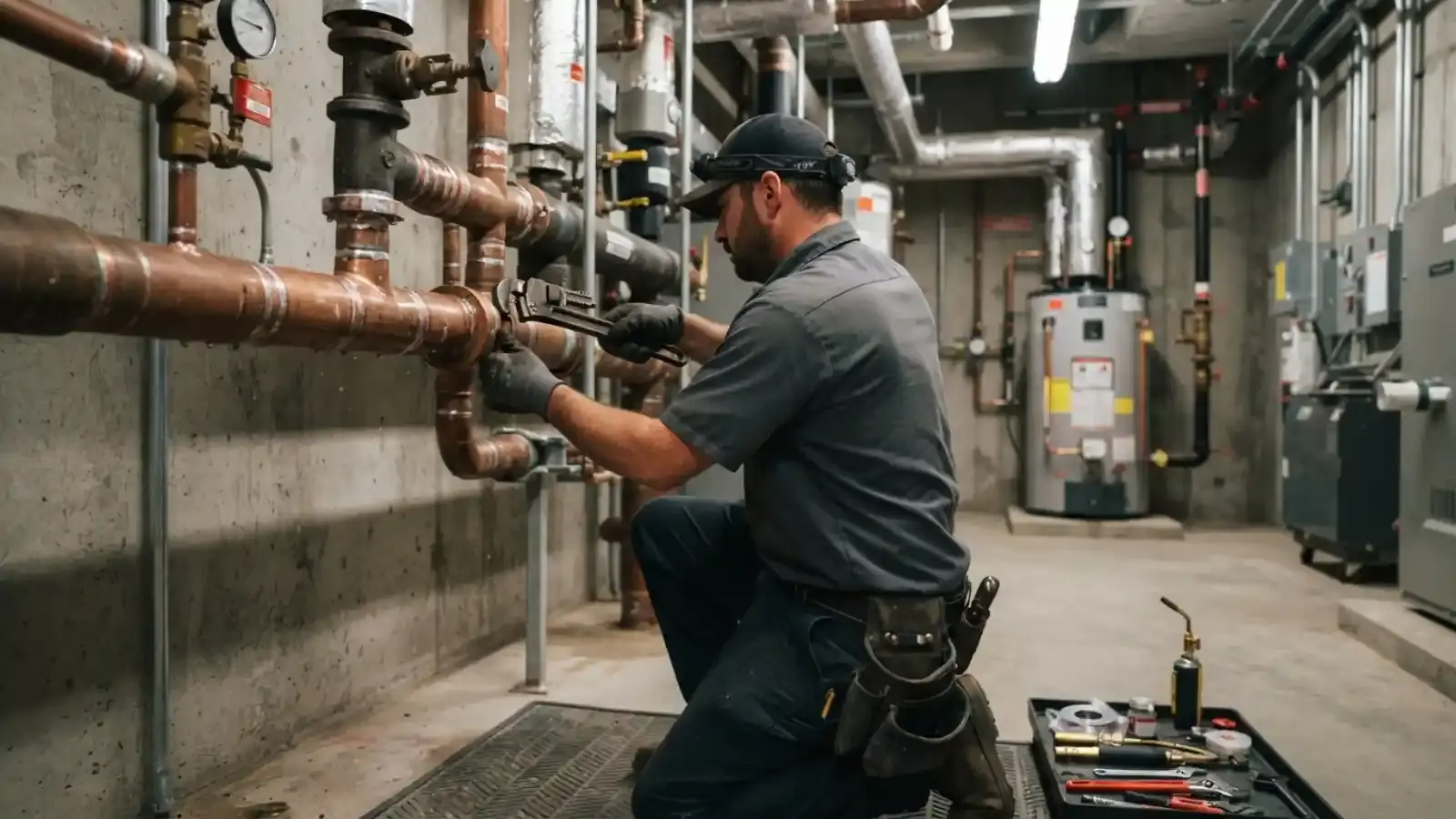
Emergency commercial plumbing in Placentia, CA covers after-hours leaks, floor drain backups, burst lines, failed fixtures and no-water calls at shops, restaurants, offices and rental properties. The line is open 24/7 at (714) 750-8637 and a licensed plumber is dispatched to your address. Tell the dispatcher the type of business and where the water is.
Commercial plumbing uses the same trades as home plumbing, at a larger scale. Pipes run longer, drains handle more load, and a failure can close a business for a day. The work often involves a property manager or landlord as well as the person on site.
When to call: the business cannot stay open
A floor drain that backs up in a kitchen, a restroom that floods or a supply line that bursts above a stockroom can close a business for the day. The first minutes are about stopping damage and keeping people safe.
These steps help while the plumber is on the way:
- Find the main shutoff and close it. Staff should know where it is. In a multi-tenant building, ask the manager which valve serves your space.
- Keep people out of wet areas. Slips are the most common injury in a flood, and standing water near power is a hazard.
- Cover or move stock and equipment. Raise cartons off the floor and unplug equipment that is near the water.
- Stop using the affected drains. Do not run dishwashers, sinks or mop sinks that feed the backup.
Tell the dispatcher if the water is sewage, since that changes the response. If it is clean supply water from a line, the work resembles burst pipe repair.
The commercial calls that come in most
Commercial calls cluster around a few problems. These are the ones the line handles most often.
Leaks of unknown source
Water showing up on a ceiling, wall or floor without an obvious pipe. Finding it means leak detection before any wall is opened.
Floor drain and grate problems
A grate that must come off now, a drain that backs up, or a floor that stays wet.
Restroom fixtures
Toilets, urinals and sinks that fail often because of heavy use.
Kitchen and grease lines
Sinks, grease traps and floor sinks in food businesses.
Water heaters
A tank that leaks or fails to heat for a shop or a small office.
Main line backups
Several fixtures at once, usually pointing to the building's main drain.
Commercial drains, grease and floor sinks
Restaurants and food shops send fats, oils and grease down drains all day. A grease trap catches part of it, but a trap that is full lets grease pass through to the line, which then narrows and backs up. Floor sinks and floor drains in kitchens clog with food solids and grease together.
For a main line or a floor drain that clogs repeatedly, the answer is usually a cable, a camera look and then hydro jetting to scour the pipe wall. Commercial drain and trap work is governed by the California Plumbing Code, Title 24, Part 5, which rests on the UPC. Grease trap pumping and cleaning is its own schedule, and the dispatcher can tell you how a given trap is handled when you call.
Commercial problems and the response they usually need
The table below shows how the plumber usually approaches the common commercial problems.
| Problem | First response | Follow-up |
|---|---|---|
| Restroom flooding | Shut off the fixture supply, clear the stoppage | Check the flush valve, the wax seal and the branch line |
| Floor drain backup | Cable the drain and test the flow | Camera look and jetting if it repeats |
| Roof or ceiling leak from plumbing | Isolate the line and stop the flow | Locate the break and repair |
| No water at the business | Check the main, meter and building shutoffs | Repair the failed valve or line |
| Sewer smell in a tenant space | Check traps, vents and floor drains | Camera inspection if the smell persists |
Landlords, property managers and tenants
Rental and commercial buildings add a second party to the call. These points help the visit go smoothly.
- Who authorizes the work. The dispatcher asks whether the caller is the owner, the manager or a tenant, because that decides who approves the price.
- Access to the space. If the tenant must let the plumber in, say so, and give a name and a number for the person on site.
- Which valves serve which space. In shared buildings, a main for one tenant can sit in a hall closet or a roof room.
- Work orders and invoices. Managers who need paperwork for a work order can ask for it at the time of the call.
Scope, access and honest limits on larger jobs
Small commercial calls such as a clogged restroom drain, a failed fixture or a leaking valve are handled like any emergency visit. Larger jobs, such as a multi-unit leak search or a long line repair, may need a site visit and a written scope before a price is final.
Some commercial work depends on equipment, access or building records that are not known until the plumber is on site. Tell the dispatcher what you know, and the plumber will say plainly what can be done today and what needs a second visit.
How a commercial visit runs
- 01
Give the type of business and the problem
Say what the building is, where the water or backup is, and whether anyone is hurt or exposed.
- 02
Stop the damage
The plumber finds the shutoff, isolates the line or clears the stoppage so the building can stabilize.
- 03
Price before the work starts
A clear price is given for the repair, and you or the owner approve it.
- 04
Test and document
The system is tested, and the plumber explains what failed and what to watch.
Placentia businesses and building age
Placentia's population grew from about 5,000 in 1960 to nearly 25,000 by 1970, so some of the buildings around town are decades old. Older restrooms, shutoff valves and main drains carry that age with them, and failures are often traced to a valve or a joint rather than a new problem.
Placentia's own sanitary sewer is roughly 50 to 100 years old, so a repeat backup at a business may be in the city main rather than the building. Public Works at (714) 993-8131 is the office to ask about the main, and a camera look shows where the trouble sits.
What shapes the price of commercial plumbing work
A clear price is given before work starts. These are the factors.
A single fixture is a small job. A multi-fixture or whole-building problem is larger.
Ceilings, roofs and shared spaces take longer to reach.
Larger pipes need heavier tools.
Landlords may require approvals or work hours.
After-hours dispatch carries a different rate than a scheduled daytime visit.
Business insurance varies widely. A sudden pipe failure may be covered while a worn part is not, so ask your agent and keep photos and the invoice.
Want your real number for your property? Call (714) 750-8637
Questions about commercial plumbing in Placentia
Yes. The line at (714) 750-8637 is answered around the clock, including nights, weekends and holidays. Say that it is a business so the dispatcher asks the right questions.
The plumber starts with the visible signs and the water meter. Hidden leaks are covered under leak detection, and the scope depends on what the building allows.
Floor drains and grease-laden lines are cleared with cable and jetting. For trap pumping, tell the dispatcher what you have and they will explain how it is handled.
Yes. Give the dispatcher the unit address, a contact for access and who approves the price.
Yes, when the plumber has access. Say what you need removed and where it is.
A camera look shows whether the trouble is in your line or the city main. For the main, Public Works at (714) 993-8131 is the office to contact.