
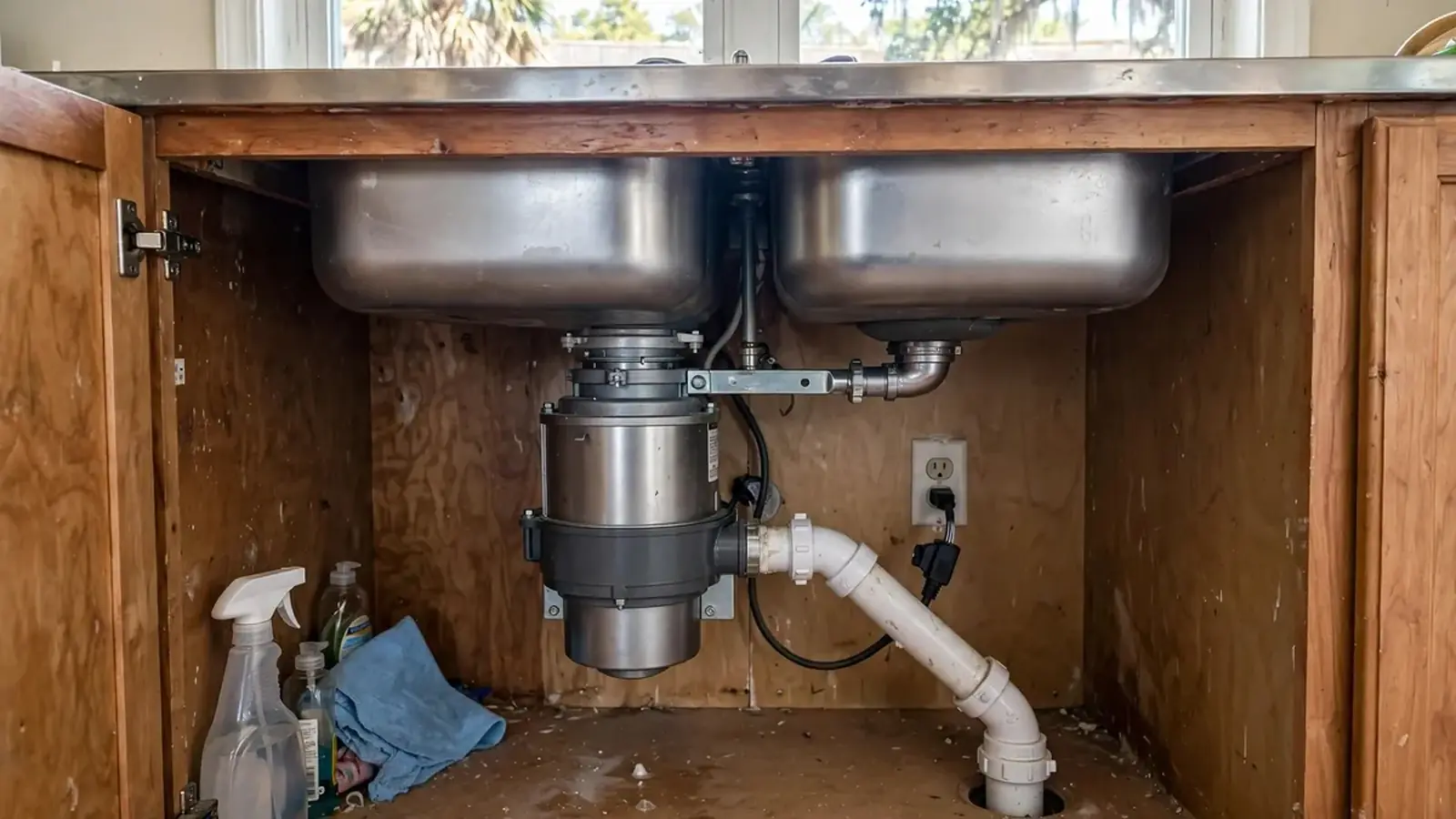
Emergency garbage disposal repair in Placentia, CA covers a disposal leaking from the body or the drain seal, a unit that hums but will not spin, and a sink that fills with dirty water when the dishwasher runs. The 24/7 line is open at (714) 750-8637 and a licensed plumber is dispatched to your address. Switch the disposal off at the wall and keep your hand out of the drain.
Disposal repair is the work of finding why the unit stopped, leaked or backed up, and fixing it or replacing it. The causes are usually a jam, a failed seal, a clogged trap, or a dishwasher hose that was disconnected. The visit includes the sink and dishwasher connections, not only the unit.
Safety steps for a leaking disposal or a sink that will not drain
A leaking disposal often shows up as a puddle in the cabinet, or as damp wood that smells after a few days. A sink that fills with gray water means the drain beyond the unit is blocked.
Do these first:
- Switch the disposal off at the wall and at the breaker. Never put a hand into the unit or the drain, even when it seems dead.
- Stop running water into the sink. Skip the dishwasher too, since its hose empties into the same line.
- Put a bucket and towels under the leak. Find where water collects. A drip from the bottom or the side means the unit itself has failed.
- Leave drain cleaner alone. It sits in a blocked line and splashes on whoever works on it next.
If several fixtures in the house are slow, the problem is past the disposal. Treat it like the main-line backup described on the drain cleaning page.
What the plumber checks, in order
Disposals look simple, but several things can fail at once. This is the usual order of checks.
- 01
Power and reset
The plumber checks the switch, the outlet and the reset button on the bottom of the unit.
- 02
Jam and flywheel
A hex key turned from underneath frees many jams. A seized motor is replaced rather than repaired.
- 03
Seals and mounting
The sink flange, the gasket and the drain connections are checked for the source of the leak.
- 04
Trap and branch line
The trap and the line to the wall are checked, because food that passes the grinder lands there.
Repair or replace the disposal
Many disposals are repairable, but not all of them are worth it. The table shows how the choice usually goes.
| Problem | Repair is likely | Replacement is likely |
|---|---|---|
| Humming, will not spin | Jam cleared with a hex key | Seized motor or burned windings |
| Leak at the top flange | New putty or gasket | Corroded or cracked flange |
| Leak from the body or the bottom | Almost never repairable | The housing has failed, so the unit is replaced |
| Leak at the drain connection | Tighten or replace the gasket | Rarely needed |
| Unit many years old and failing | Only if the repair is minor | A new unit usually costs less than repeated visits |
The dishwasher line, the air gap and other loose ends
The disposal and the dishwasher share a drain, and many calls involve both.
- The dishwasher drain hose. It connects to a port on the disposal. If the knockout plug was never removed on a new unit, the dishwasher will not drain.
- A reattached water supply. The plumber can reconnect the dishwasher supply and the disposal drain after a sink or faucet swap.
- A high loop or air gap. The hose is raised before it joins the line, which prevents dirty water from running back into the dishwasher.
- A loose mounting ring. The unit hangs from a ring under the sink. A loose ring makes it shake, and the seal leaks.
What not to put down a disposal
A disposal grinds soft food and little else. Grease, coffee grounds, pasta, rice and fibrous vegetables such as celery and corn husks collect in the trap and branch line. Bones and fruit pits can jam the unit.
Run cold water before, during and for a few seconds after grinding. Cold water keeps fat solid so it is carried along rather than coating the pipe. Chemical drain cleaners and hot grease both harm the line, and the installation rules for disposals sit in the California Plumbing Code, which is based on the UPC, and a repeat clog after cleaning is a reason to ask for hydro jetting.
Placentia kitchens and permits
Placentia's housing grew fast between 1960 and 1970, and many kitchens still have older sink plumbing that was built before disposals were common. A tight trap or a worn branch line can make a new disposal back up from the first day.
The City of Placentia's Building and Safety office at (714) 993-8124 lists garbage disposals on its permit form, so ask them whether your job needs one. Hard water, with Golden State Water's average at 188 mg/L, also leaves scale in drain parts. If you are on Yorba Linda Water District service, check your bill.
What changes the price of a disposal repair
A clear price is given before work starts. These are the factors.
A cleared jam is quick. A new unit adds the cost of the disposal and the mounting kit.
Motor size and features change the price of a replacement.
A bad trap, a worn drain line or a dishwasher hose adds work.
A slow leak may have soaked the base. That is repaired or noted for you.
After-hours dispatch carries a different rate than a scheduled daytime visit.
Worn disposals are maintenance and are not usually covered. A sudden leak that ruins cabinets or flooring can be a separate claim, so take photos and read your policy.
Want your real number for your disposal? Call (714) 750-8637
Questions about garbage disposal repair in Placentia
Yes. The line at (714) 750-8637 is answered around the clock. Tell the dispatcher if water is leaking under the sink so the call is dispatched as urgent.
A jam is the most likely cause. Switch it off, leave it alone, and call. A hex key at the bottom frees many jams, and a motor that stays stuck is replaced.
The dishwasher drains through the disposal. A blocked trap or branch line sends the water back into the sink. A cable run through the line usually clears it.
Often, when the schedule allows. Same-day appointments are offered when available, and the plumber brings common sizes.
Yes. Reattaching the dishwasher water line and the drain hose is part of a disposal job, and the faucet repair page covers the sink side.
A leak at the top flange is often fixable. A leak from the body or the bottom means the housing has failed and the unit is replaced.